


I’ve always loved a good challenge.
The kind with a plan, a schedule, and a finish line.
Training for a marathon.
Signing up for something like 75 Hard.
Rucking for 24 hours straight because someone said it was a terrible idea.
There’s something about sacrifice, structure, and doing the thing people quietly think you won’t finish. I like proving myself, and others, wrong.
So it’s no surprise that for most of my life, I treated Lent the same way.
Not in a bad way.
Actually… in a very me way.
Lent felt like training season.
There was a start date, a finish line, and somewhere in my head… a clipboard.
The question was always the same:
“What can I give up for forty days?”
And for a long time, I loved that question.
As a kid, the challenges were manageable.
As I got older, they got tougher.
Swearing....does it count if I replaced swear words with new words that everyone knew what I meant?
Meat...there is only so much beans and tofu you can eat to meet your protein goals. Holy farts Batman.
Alcohol...particularly difficult when my birthday and St. Patty’s day are in back to back weekends.
Each year, sacrifice slowly became the proof of commitment.
If it was hard, it must be meaningful.
If it was uncomfortable, it must be holy.
Looking back, I can see how much that fed my perfectionism. The part of me that believes effort equals worth.
That mindset has its place.
It can build discipline.
But done wrong, it has a cost.
Somewhere along the way, faith quietly became another thing I was trying not to fail at.
I didn’t fully see that until I became a dad.
When Challenge Meets Family Life
When we tried Lent as a family, something became obvious pretty quickly.
The challenge framing that motivated me…
created pressure for everyone else.
One year, we tried giving up screens.
My wife and I quickly realized how much we relied on them.
On the plus side, we played more games, drew more pictures, and actually finished a few books. It felt meaningful.
It also led to some impressive binge-watching once Lent ended.
Growth is rarely linear.
Another year, we tried giving up sweets.
That’s when I learned how many holy moments involve cupcakes.
Birthdays.
Classroom parties.
That random Tuesday when someone’s grandma shows up with cookies.
Which led to the real questions:
“What if I forget?”
“What if I eat one?”
“Does that make me a bad person?”
“Is God mad at me?”
Nothing exposes your theology like a kid asking if God is mad about a cupcake.
Those moments unexpectedly opened the door to some of our best conversations about forgiveness and grace.
Still, the overall experience carried more friction, and more fear, than I had hoped.
What felt like discipline to me felt exhausting to them.
And that’s when I started to wonder if I was asking the wrong question.
A Different Way to Think About Lent
Last year, we tried something different.
Instead of asking,
“What should we give up?”
We asked,
“What do we want to practice?”
That small shift changed the tone immediately.
After some discussion, some negotiation, and at least one dramatic sigh, we landed on something simple:
Prayer at a meal.
Any meal.
Any place.
Any time.
Home.
Restaurant.
Drive-thru.
Awkward? Sometimes.
Perfect? Never.
But repeatable.
What surprised me most was the built-in accountability. It felt less like a challenge and more like a good training partner. Not someone yelling at you for one more rep, but someone who expects you to show up.
There were plenty of days when, left to my own devices, I would’ve scarfed my food, stayed half-present, and gone right back to work.
But more times then not, someone would remember.
Someone would pause the moment.
Someone would pull us back.
And if we forgot one day, we didn’t spiral.
We didn’t restart the clock.
We just returned the next.
Sometimes we doubled up.
Sometimes we rotated prayers when the usual ones went stale.
Eventually, we opened it up to whatever was on someone’s heart.
No scoreboard.
No failure.
No dramatic family meeting about “doing Lent right.”
Just practice.
What the Science Says (and Why Habit Stacking Works)
Turns out, this isn’t just a faith thing.
It’s a human brain thing.
Real change tends to stick not when we rely on motivation or willpower, but when we attach a new practice to something that’s already happening.
In other words: habit stacking.
It works because:
Your brain loves cues
Willpower is unreliable (especially at dinner)
Repetition beats motivation every time
Giving something up leans heavily on willpower. Adding something leans on structure, cues, and repetition.
When we tied prayer to meals, something that was already part of our day, we weren’t fighting the schedule.
We were anchoring the practice.
That’s the heart of habit stacking: attaching a small, meaningful action to a reliable moment.
Meals.
Bedtime.
Morning coffee.
The drive to school.
It’s a strategy I’ve found myself returning to again and again, including when I started building the Daily Dad Reset program.
The Reflection
I still respect challenge.
There’s value in restraint.
There’s growth in discipline.
But I’ve learned this:
Challenge without grace makes it harder to keep going.
What shaped our family most wasn’t what we avoided for forty days.
It was what we returned to
again and again
without needing it to be perfect.
Prayer didn’t magically calm dinners. It didn’t fix attitudes. It didn’t stop spilled milk or random farts.
But it created a pause.
A moment of shared attention.
A reminder that faith isn’t proven by never missing a step…
but by choosing to return after we do.
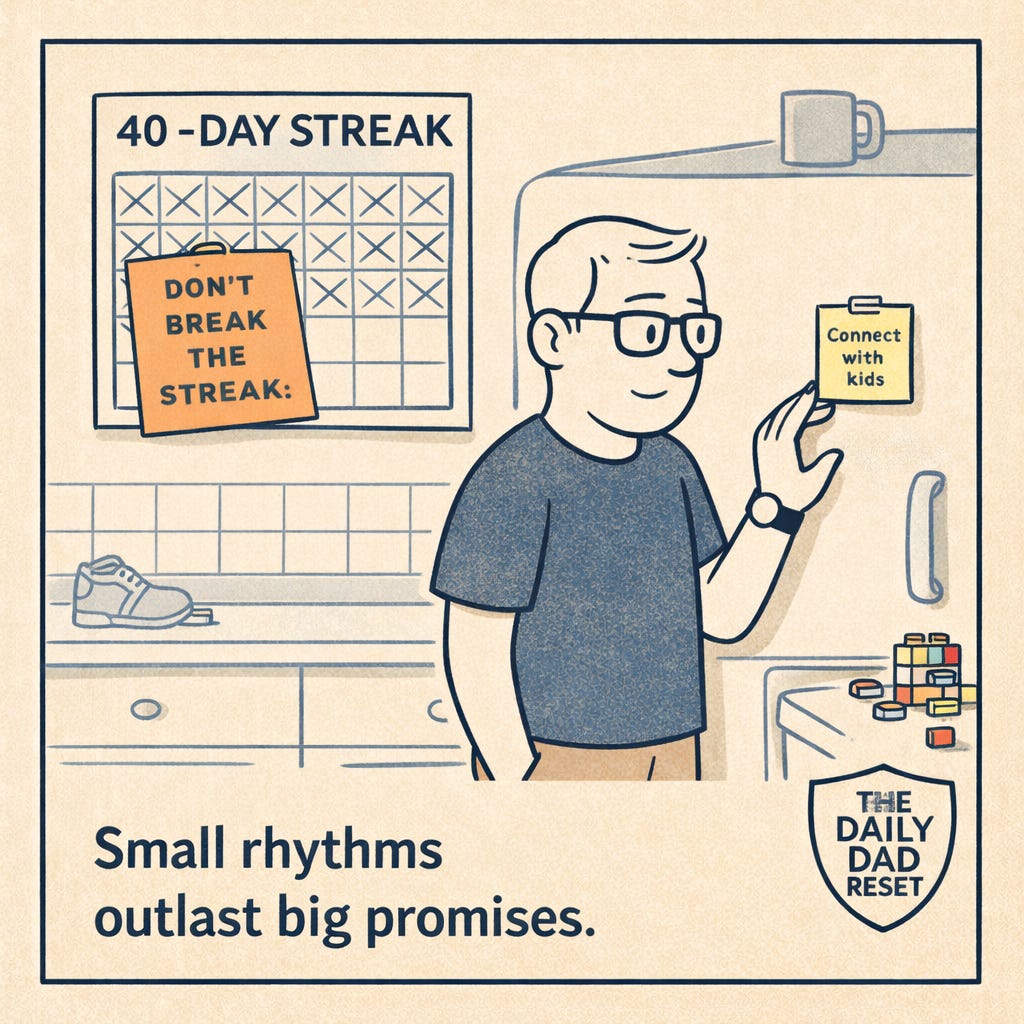
It turns out God is less interested in my perfect streak…
and more interested in whether I come back tomorrow.
The Scripture
“Train yourself for godliness.”
— 1 Timothy 4:7
Training assumes missed days.
Practice.
Showing up again without starting over.
Its true in sports training.
Its true in faith training.
Its definitely true in dad training.
The Reset Reminder
If Lent has always felt like another challenge to conquer,
try this:
Don’t aim for perfect. Aim for a small daily reset:
One small habit.
One moment you already have.
One rhythm your family can actually keep.
That’s how grace gets practiced instead of performed.
And it’s a pretty good way to begin this Lent.
If you’re looking for a simple way to try this as a family, I put together a short Lent rhythm we’ll be using at our table, nothing heavy, just something to return to when you remember → You can visit it here.
This is such a solid reframe. The shift from challenge to practice changes everything, especially with kids in the mix. “Faith isn’t proven by never missing a step, but by choosing to return after we do” really landed. That feels way more sustainable than chasing a perfect streak. Really thoughtful work here.
Small daily resets for the win! 🙌