


The other day, one of my boys said something that sounded small but landed heavy.
“I’m just bad at math.”
Not angry.
Not dramatic.
Just stated like a fact. Like gravity.
Every instinct in me wanted to jump in fast.
“No you’re not.”
“That’s not true.”
“You’re actually really good at math.”
I’ve said all of those before. You probably have too.
They sound supportive.
They sound encouraging.
They just… don’t work very well.
Because when a kid (or an adult) says something like that, they’re not asking for a correction.
They’re telling you what story just showed up in their head.
And if we rush to erase the thought instead of examining it, we miss the chance to teach something far more important than confidence.
We miss the chance to teach how to think.
Why Cheerleading Falls Flat
Most of us were raised to replace negative thoughts with positive ones.
Think better.
Say nicer things.
No fear.
Heck, I had an entire wardrobe of those early 90’s marvelous No Fear shirts.
The problem is, the brain doesn’t work like a whiteboard.
You can’t just erase a thought and write a new one over it.
Especially under stress.
When someone says, “I’m bad at math,” and we respond with, “No you’re not,” the brain quietly replies:
Yeah… but it still feels true.
Now the thought hasn’t gone away.
It’s just gone underground.
And underground thoughts tend to run the show.
Everything‑is‑awesome parenting works great… right up until life isn’t.
The Skill We Actually Need
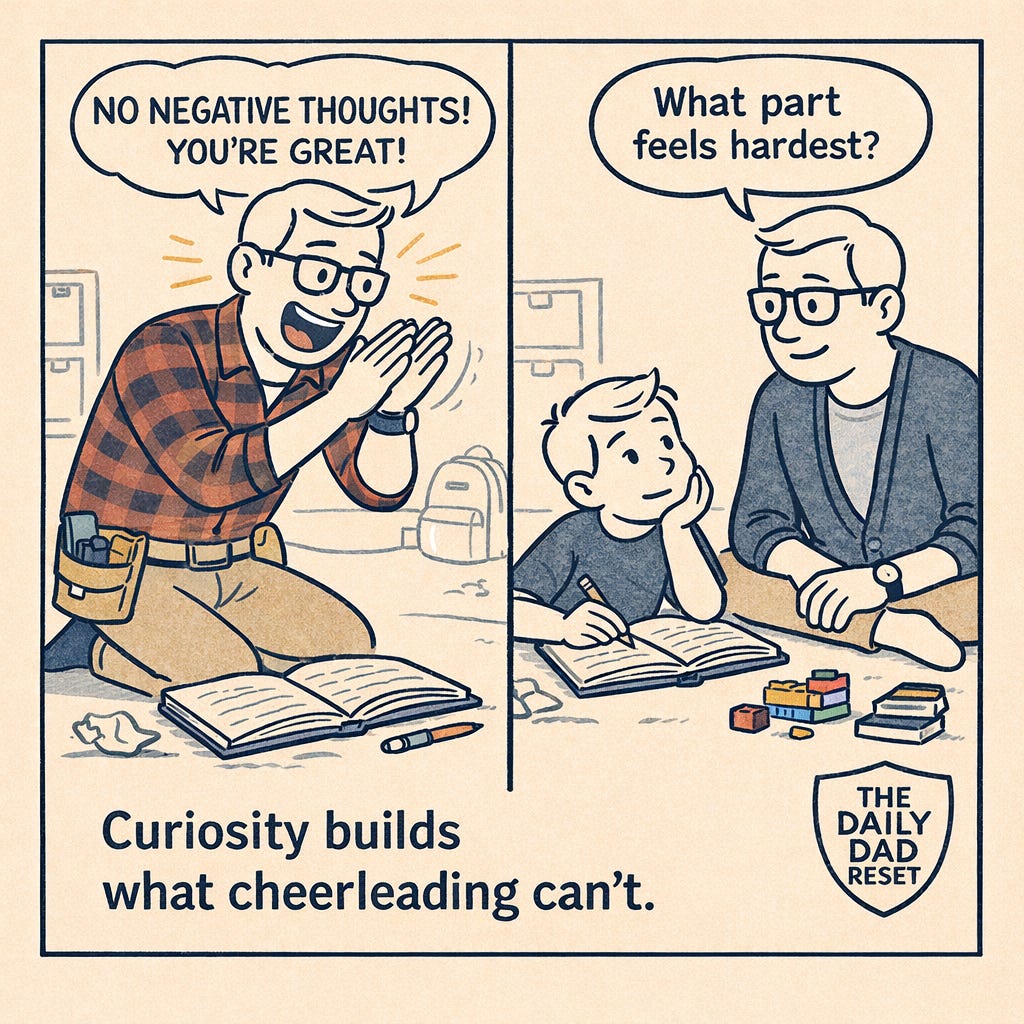
Instead of correcting the thought, we can challenge it.
Not aggressively.
Not like a debate.
More like a curious adult sitting next to a kid on the floor.
The shift is simple, but powerful:
From correction → to curiosity
It sounds like:
“What makes you think that?”
“Shucks, I remember last week you getting an A on a math test, could today just be a bad day?”
“When does this feel hardest?”
“Has there ever been a time it felt a little easier?”
We’re not telling them what to think.
We’re teaching them how to question the story.
And that’s where resilience starts.
Because distorted thinking almost always leads to distorted action.
“I’m bad at math” quietly turns into:
“I’m not doing my math.”
But when we learn to slow the thought down and examine it, we interrupt that chain reaction.
That skill lasts a lot longer than a pep talk.
This Works on Us Too
This isn’t just a kid thing.
We do the same thing in January.
“I already messed today up.”
“I can’t stick with anything.”
“I should be better at this by now.”
Those thoughts show up fast.
And if our only move is to argue with them or power through, we usually end up right back where we started.
But when we slow down and ask:
“Is that actually true?”
“What expectation just didn’t get met?”
“What part of today still counts?”
The story loosens its grip.
Not because we brute-forced it out.
Not because we went full caveman:
“That thought bad. Good thoughts good.”
But because we examined it.
Where Microblessings and Formation Meet
Microblessings help us stay regulated.
Challenging thoughts helps us stay oriented.
Together, they do something important:
They keep us from turning one hard moment into a full verdict on who we are.
Instead of:
“I failed.”
We get:
“That was hard. What can I learn from it?”
That’s not positive thinking.
That’s resilient thinking.
And resilient thinking is far more productive than convincing your child everything is awesome.
Because pretending things are fine might keep the peace for a moment—but it doesn’t build the muscles kids need when things actually aren’t.
Sure, they love that song from The Lego Movie.
It’s catchy.
But even Emmet doesn’t believe it by the end.
The Scripture
“Be transformed by the renewing of your mind.”
— Romans 12:2
Renewing hardley means replacing everything all at once.
It means returning.
Revisiting.
Reframing what we thought we already knew.
Even Jesus asked questions far more often than He gave answers.
The Reset Reminder
The next time a hard thought shows up—
in you or your kid—
resist the urge to correct it immediately.
Get curious instead.
Ask where it came from.
Ask what it’s protecting.
Ask if it’s telling the whole story.
Because resilience isn’t built by never having hard thoughts.
It’s built by learning how to slow them down before they turn into actions.
That’s a skill worth practicing.
Because when “everything is awesome” stops working, thinking clearly is what keeps us steady.
And January is a pretty good place to start.
Great post. Sometimes kids (or anyone, really) also just want to be heard. They don’t want to debate their feelings or be inadvertently invalidated. Especially from well meaning parents.
amazing article, Jeremy! I love how you think and I really like how you encourage your kids to think and reflect as well. they are going to be astute, emotionally mature adults when they grow up thanks to you being their dad!