


We struggle to believe we’re allowed to change without punishment.
Apparently growth is only legitimate if it hurts a little.
Preferably a lot.
Preferably forever.
Which is exhausting.
And strangely joyless.
And a terrible long-term strategy for anyone who wants both growth and peace.
Somewhere along the way, many of us learned that growth requires pressure. That improvement comes from being hard on ourselves.
That if we let up…
even a little…
we’ll slide backward.
So when grace shows up, it feels suspicious.
It feels like lowering the bar.
Like letting ourselves off the hook.
Like something that might sound nice but won’t actually work.
And that belief quietly shapes how we talk to ourselves.
Where This Voice Came From (A 70s–90s Inheritance)
For a lot of us, this mindset didn’t come from nowhere.
It was formed in the background of how many of us grew up.
In the 70s, 80s, and 90s, the message was subtle but steady:
Don’t be soft.
Suck it up.
Do better next time.
Feelings are fine… just not right now.
Motivation was external. Praise was conditional. Correction was public.
You got attention when you performed.
You got pressure when you fell short.
And you learned…
without anyone saying it out loud…
that discomfort meant you were being shaped.
So you internalized it.
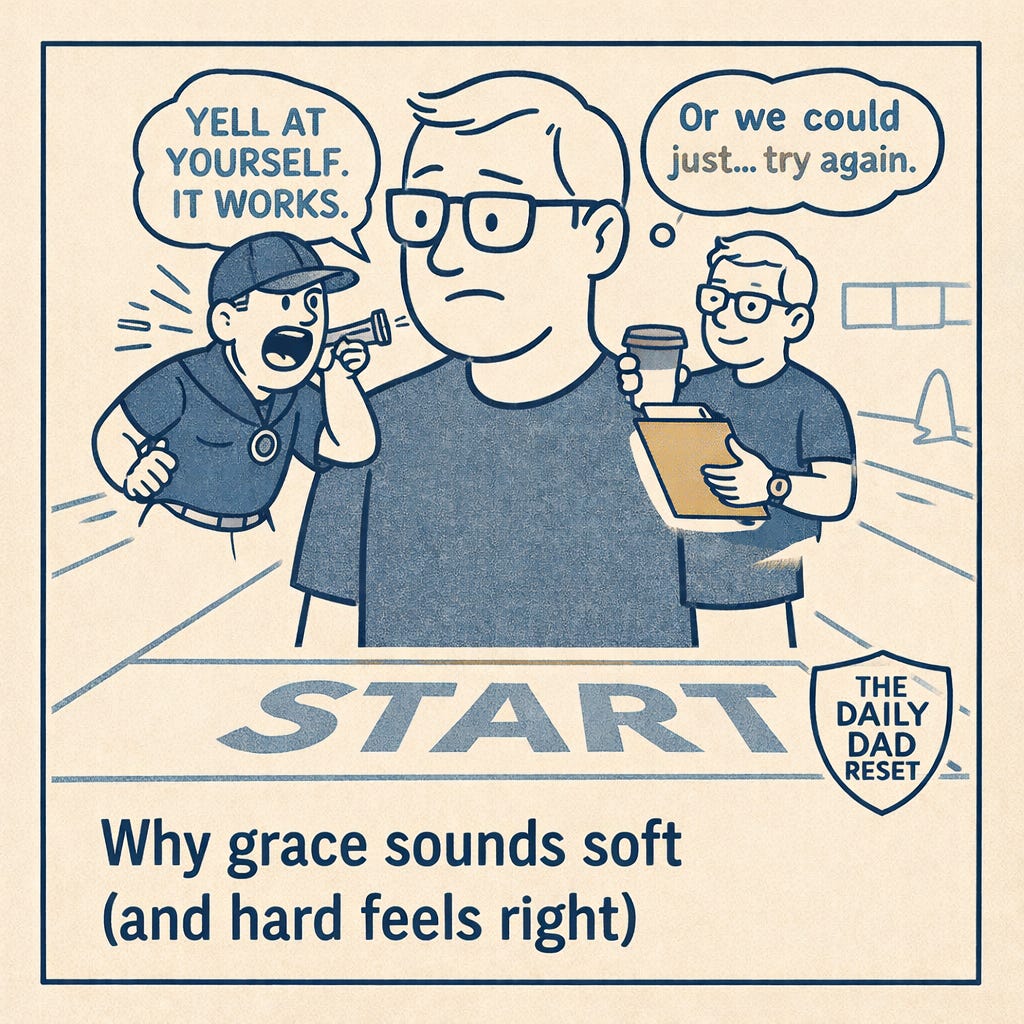
The coach’s voice.
The teacher’s tone.
The look that said, “You should know better by now.”
That became the soundtrack.
And somewhere along the way, discipline got tangled up with shame.
Why We Trust the Harsh Voice
There’s a voice most of us know well.
The one that never pays rent, eats all your snacks, and still feels wildly qualified to critique your life choices…
while offering exactly zero solutions.
It’s blunt. Demanding. Sometimes cruel.
But it feels productive.
It feels like forward motion.
Like control.
Like the kind of pressure that promises results now…
even if it quietly robs us of peace later.
Because it promises results.
It says things like:
“You should be better by now.”
“If you don’t stay on yourself, you’ll fall apart.”
“Pressure is how you improve.”
That voice sounds confident. Authoritative. Almost helpful.
And here’s the most unsettling part:
It probably has helped you improve before.
You got results.
You pushed through.
You achieved something.
Which is why it starts to feel like the only path forward.
Grace, on the other hand, sounds soft.
And soft sounds suspicious in a culture trained to trust pressure more than peace.
Like something that belongs on a throw pillow, not in a plan that’s supposed to change your life.
So softness gets mistaken for weakness.
The Lie Beneath the Lie
Here’s the deeper belief we rarely name:
If I’m not hard on myself, I’ll stop trying.
As if the only thing keeping me from total collapse is a steady stream of internal yelling.
So we keep the harsh voice around as motivation.
We trust it to keep us sharp.
To keep us disciplined.
To keep us moving.
But over time, it makes us hesitant not strong.
Because when every mistake is punished internally, effort starts to feel dangerous.
And when effort feels dangerous, we avoid it.
Not because we’re lazy.
But because we’re tired of being attacked by our own thoughts.
What Grace Actually Does
Grace isn’t ignoring mistakes.
It’s responding to them without condemnation.
Grace doesn’t say, “It doesn’t matter.”
It says, “This isn’t the whole story.”
That difference matters.
Because shame shuts down learning.
It might produce short bursts of effort,
but it rarely produces lasting change, or peace.
But safety allows it.
And the same is true for our kids.
The way we respond to ourselves teaches them what to do when they fall short.
Turns out our kids are always watching.
Even when we’re pretty sure they’re not listening to a word we say.
They’re learning whether mistakes mean punishment…
or growth.
The Scripture
“For as he thinketh in his heart, so is he…”
— Proverbs 23:7
This is less about positive thinking
and more about formation.
What we rehearse internally shapes who we become.
A harsh voice forms fear.
A gracious one forms courage.
The Reset Reminder
This week isn’t about fixing your thoughts.
It’s about questioning a belief:
Does being hard on yourself actually help you grow?
Or has it just been the loudest voice in the room?
Grace isn’t lowering the standard.
It’s changing the fuel…
from pressure to peace.
And sometimes, that’s the only way growth actually lasts.
Turns out yelling at yourself isn’t a growth strategy.
Who knew.
Apparently my internal coach yelling “DO BETTER” at full volume isn’t the growth strategy I thought it was. Grace as fuel instead of pressure feels risky, but also way more livable, for me and the kids watching me figure it out. Good piece DDR
It's surprising how much of our internal dialogue our kids pick up on. Because our internal thoughts shape our actions, which they internalize. When we start by giving ourselves grace, our kids see it and learn that responding to situations with grace is the best way to respond