


Story
It happens all the time.
Sometimes it is about the harmful ingredients in toothpaste.
Sometimes it is about trying to find the perfect opening activity for a Cub Scout Pack meeting.
This time, it was about something I heard in a podcast from John Eldredge called the One Minute Pause. Nothing long or deep. Can you pause for 1 minute? When something goes well. When something is wrong. When you are angry. When you are grateful. When you are distracted.
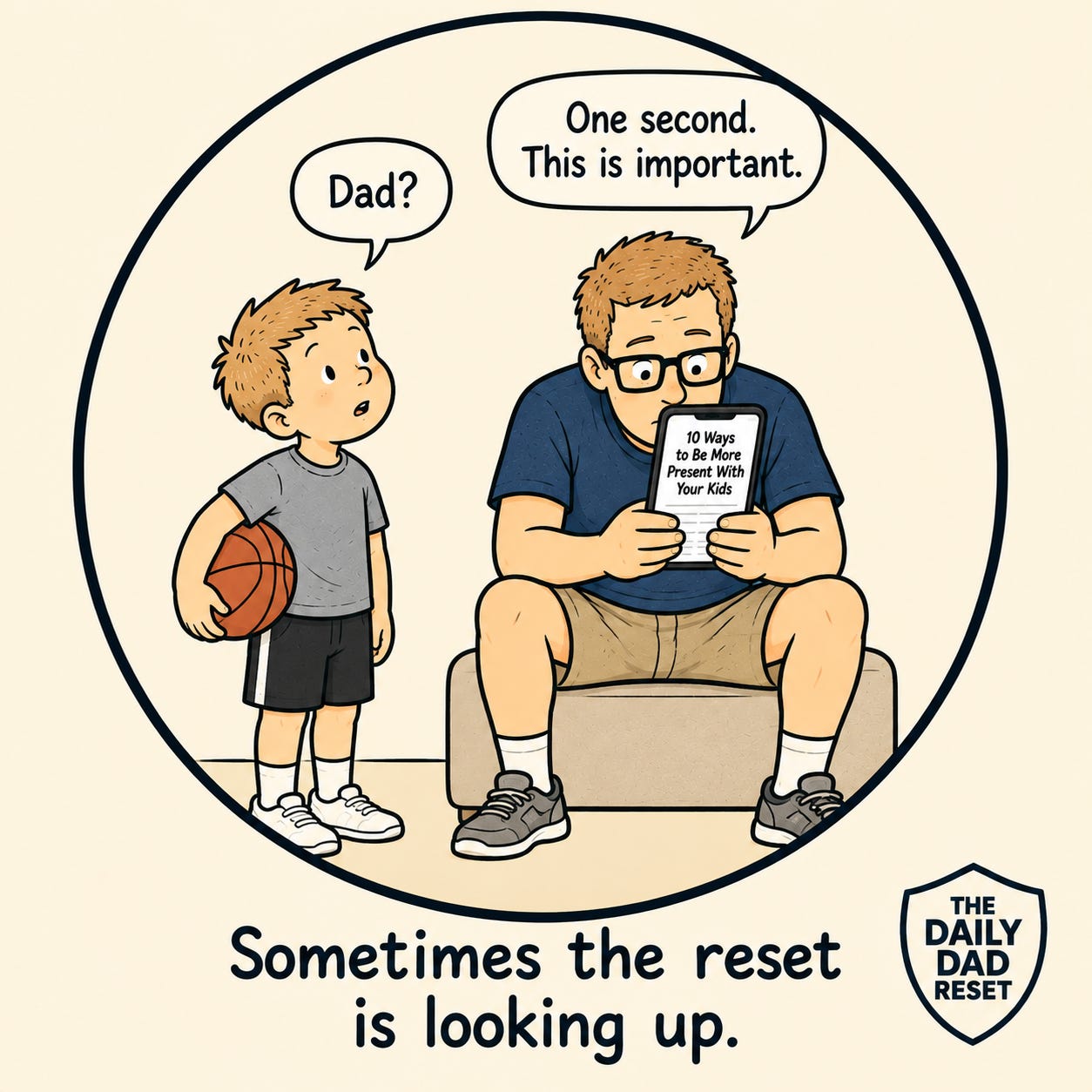
I have noticed that I can be with my kids but not be connected to my kids. Just in straight up autopilot mode. My mind is thinking about a conversation I wish I handled differently, or a professional development I am running next week, or what kind of toothpaste is best for older men. None of them are more important than being present with my kids, but yet my brain treats each one like an emergency requiring my immediate attention.
Lets just say, the idea of pausing for one minute, landed.
Then I read a post that took it one step further with a breath in and breath out prayer. Then a video appeared from someone I have never heard of, that actually keeping your mind completely free of thought for 1 minute was the only way towards inner peace. At some point, I start wondering:
Is God, the universe, fate, or my Uncle Fred trying to tell me something?
Maybe.
Or maybe I clicked on one video about being a better father, and my algorithm decided I needed seventeen more. Sometimes I think that merely pausing over a video is enough for the algorithm to start reproducing similar content faster than rabbits do...
you know what.
The difficult part is that my feed isn’t filled entirely with nonsense. It introduces me to people, ideas, and movements that inspire me. It helps me make connections. Sometimes it gives language to something I have felt but couldn’t explain. Every click feeds me more.
More ideas.
More inspiration.
More dopamine.
More apparent revelations.
By the end, I have discovered solutions to thirteen problems I didn’t know I had,
internalized almost none of them,
and can’t actually remember what my mind wanted answered.
Don’t worry. My brain will remember it at 3 a.m. and flood my body with enough adrenaline that I will wake up sweating, short of breath, and reaching for the same phone that started all of this...
to “calm” me down.
What I Learned
I used to think the problem was wasting time on meaningless content. I think the new trap is that meaningful content can become its own form of distraction. I have learned to trim my feed, follow people that fill my cup, and unfollow people that no longer serve a purpose. The problem still exists, I can show up to to read an article I saved from one of my favorite Substack writers and then end up consuming an endless stream of ideas about becoming a better father without staying with any one idea long enough to become a better father.
I can fool myself into believing I am going deep when I was really just splashing around in a shallow pool of meaning. Deep reflection is really just recognition. Life changing transformation is really just inspiration. And I can call it practice when all I really did was hit save on something I will probably never open again. The algorithm doesn’t give an idea room to breathe. It gives me another idea....
and another....
and another.
It may be showing me exactly what I need.
It just has no reason to let me sit with it. And because I never pause long enough to let something sink in, or actually try it, my brain swirls long after I have put my phone or computer down. Now I am playing with my kids while the hamster in my head is frantically running on its wheel never knowing why it is running and definitely never getting anywhere.
Nothing like trying to become a better father,
getting lost in your algorithm,
and then not being present with your kids because you brain is still in hamster mode.
Support
Discernment seems to require something my feed is not designed to provide:
Silence.
In The Ruthless Elimination of Hurry, John Mark Comer writes, “Continuous partial attention is our new normal.” That describes me more than I would like to admit. I can be listening to my son while also replaying a conversation from yesterday, finalizing my top three toothpaste ingredients, and holding onto an idea my feed told me could change my life. I am paying attention to everything, which means I may not be giving my full attention to anything. Especially the things that matter most, my boys.
Comer later writes, “What you give your attention to is the person you become.” That one still bothers me. Sure, I can accept that I was losing time, that’s why it is called doom-scrolling. What really smacked me around was that even the meaningful stuff was having a say in who I was becoming.
My algorithm is learning what holds my attention,
and at the same time,
what holds my attention is slowly shaping me.
Taking time to pause. To be still. To be silent. To discern. That creates space to notice what is happening inside me. It helps me separate what is merely interesting from what may actually matter.
Maybe the message comes through a sermon…
Or it comes through a conversation…
Or it comes through a 47-second video selected by a frighteningly accurate recommendation system. I’m not sure the delivery method determines whether the message is meaningful. But if I immediately swipe to the next thing, I never have to wrestle with it.
I never have to decide whether I believe it.
I definitely never have to change because of it.
Reset
The next time something stops me, I want to resist the urge to immediately consume more of it.
My first instinct is to rapidly search for three more versions of the same idea to ensure I don’t get fooled by one looney tune on the internet. Or find every podcast this person has appeared on, download them all, only never to actually listen to them.
Instead, I can pause for one minute.
Put down the phone. Let the idea exist without another one competing with it.
And ask: What is this asking me to notice?
Maybe I write down one sentence. Maybe I realize it was merely interesting. Maybe I recognize something I need to sit with a little longer.
That’s it.
One minute probably won’t provide all the answers. But it might create enough silence to hear the question. I still may not know whether the idea came from a spiritual intervention or my algorithm.
I’m beginning to think the more important question is whether I will pause long enough to listen.
Insightful and thought provoking at the same time.