
The Best Coaches Keep Kids Coming Back — Part 2
Catch up on the series:
Let’s start with defining what a dad coach is.
Not the guy trying to make sure his kid always plays shortstop.
Not the coach treating a Tuesday night little league game like Game 7 of the World Series.
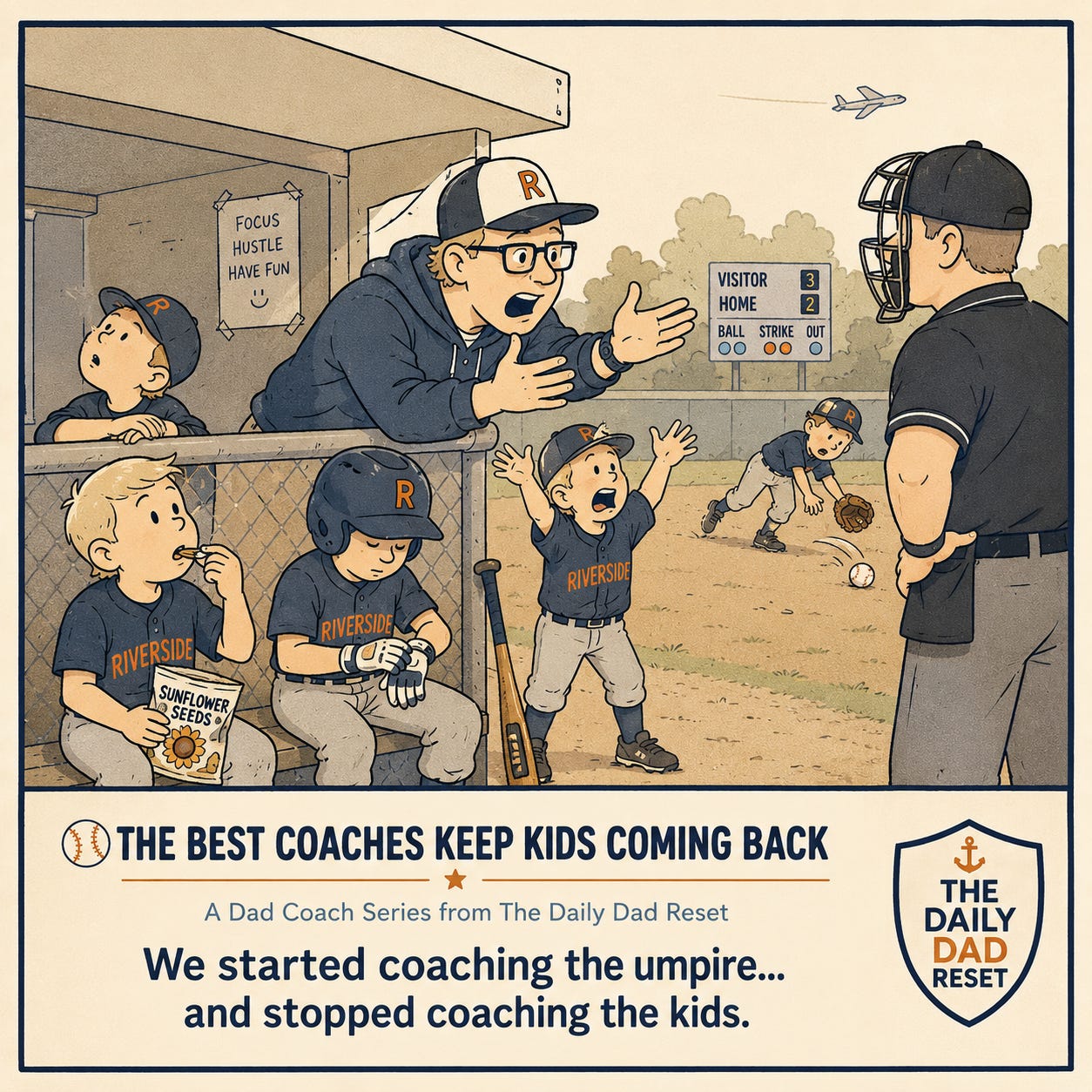
And definitely not the adult spending more energy “coaching” the umpire than coaching the kids.
A dad coach is someone trying to be a good dad and a good coach at the same time.
Someone who wants kids to:
improve
compete
build confidence
learn resilience
and still have fun playing baseball
All kids. Especially their own. Because deep down, the real win isn’t just better players. It’s kids who still love the game. Kids who learn how to respond when things don’t go their way.
And kids, especially your own, hoping you coach again next season.
Story
It started with one strike call.
Outside.
Like… objectively outside.
The kind of pitch where every dad behind the fence suddenly becomes a part-time MLB umpire.
The batter looked back.
Parents groaned.
One assistant coach muttered something under his breath.
I’m pretty sure there isn’t a Little League in the country using ABS yet, but after this call some Board Members were already discussing it like Rob Manfred was sitting behind home plate.
And before long, our dugout slowly started unraveling. Not dramatically. Just emotionally. Kids started chirping after every close call. Hands went in the air. Heads started shaking. Focus disappeared.
And all of a sudden, the entire energy of the game shifted.
Not toward:
effort
adjustments
resilience
the next pitch
Toward what was unfair. What was wrong. What the umpire missed.
And the frustrating part?
The ump wasn’t even the real problem anymore.
We were.
I was.
Because whether I realized it or not, the dugout was following my emotional focus.
Insight
Kids don’t just copy our instruction. They copy our attention.
Our reactions. Our frustration. Our emotional targets.
If coaches obsess over bad calls, kids will too.
If adults spiral about fairness, kids usually stop focusing on what they can control.
And honestly? Youth sports gives adults endless opportunities to lose emotional control.
Bad calls.
Weather.
Errors.
Playing time.
The kid eating sunflower seeds while standing in right field looking at airplanes.
But the best coaches understand something important:
A dugout almost always follows the emotional direction of the coach. Even when the coach doesn’t realize it. Because the moment kids start focusing on what’s unfair…
they usually stop focusing on what’s possible.
On what they can control.
On what the next right thing is.
Why It Works
Frustration changes the brain. When frustration rises, the brain slowly shifts from learning…
to protecting.
That’s survival mode. And survival mode rarely creates resilient baseball players. Or resilient people. Because once the brain feels threatened, it starts looking for:
blame
certainty
fairness
someone responsible
That’s where things can get dangerous in a dugout.
Our brains naturally love heroes and villains. And if we’re being honest? We rarely cast ourselves as the villain. So once the ump becomes the bad guy, the entire dugout starts emotionally organizing around it.
Now every close pitch feels personal.
Every missed call becomes proof.
Every moment confirms the story we already decided was true.
That’s confirmation bias. And once confirmation bias takes over, the brain starts collecting evidence to support it. And kids do the exact same thing. Suddenly nobody is focused on:
effort
adjustments
resilience
the next pitch
They’re focused on the villain. Because when kids stay emotionally stuck on:
the umpire
the missed call
the unfairness
They stop asking:
“What’s my next job?”
That’s why emotional regulation matters so much in coaching. Kids don’t need perfect adults. They need regulated ones. Because kids borrow emotional cues from the adults leading them. The coach sets the emotional temperature. The dugout usually follows. And when coaches stay steady?
Kids recover faster.
Refocus quicker.
And play freer.
Reset
The next time something unfair happens:
bad call
error
missed opportunity
frustrating inning
Pause before reacting. Then redirect the focus. Ask:
“What’s the next right thing?”
Not:
“Was that fair?”
“How did he miss that?”
“What are we doing?”
Next pitch.
Next play.
Next response.
Because baseball gets really hard the moment frustration becomes the loudest voice in the dugout.