


This post is the third in a series exploring the wonderful, chaotic, occasionally humbling world of being a dad and coaching youth sports. This series is less about elite drills, perfect mechanics, and turning nine-year-olds into MLB prospects… and more about helping kids love the game they’re playing. If you care not only about wins, but also kids having fun, building confidence, getting better, and wanting to come back next season, this series is for you. So far we’ve explored:
Let’s start with defining what a dad coach is.
Not the guy trying to make sure his kid always plays shortstop.
Not the coach treating a Tuesday night little league game like Game 7 of the World Series.
And definitely not the adult giving a full TED Talk on swing mechanics after every strikeout.
A dad coach is someone trying to be a good dad and a good coach at the same time.
Someone who wants kids to improve, compete, build confidence, learn resilience, and still have fun playing baseball.
All kids.
Especially their own.
Because deep down, the real win isn’t just better players.
It’s kids who still love the game.
And kids, especially your own, hoping you coach again next season.
Story
One kid struck out looking.
Totally froze.
And before he even got back to the dugout, my brain had already prepared approximately 47 coaching points. Stride earlier. Load sooner. Watch the release point. Attack the fastball. Don’t drift. Hands inside the ball. Breathe. Compete. Relax. Probably solve world hunger while you’re at it.
The poor kid sat down next to me still emotionally recovering from the strikeout…
and I was preparing to deliver what basically amounted to a baseball-themed hostage negotiation.
And if I’m being honest? This wasn’t really about helping him anymore. It was about my discomfort. My frustration. My need to fix the moment.
Because adults hate watching kids struggle.
Especially our own. So we start talking.
More instruction.
More correction.
More pressure.
And somehow we convince ourselves:
“I’m helping.”
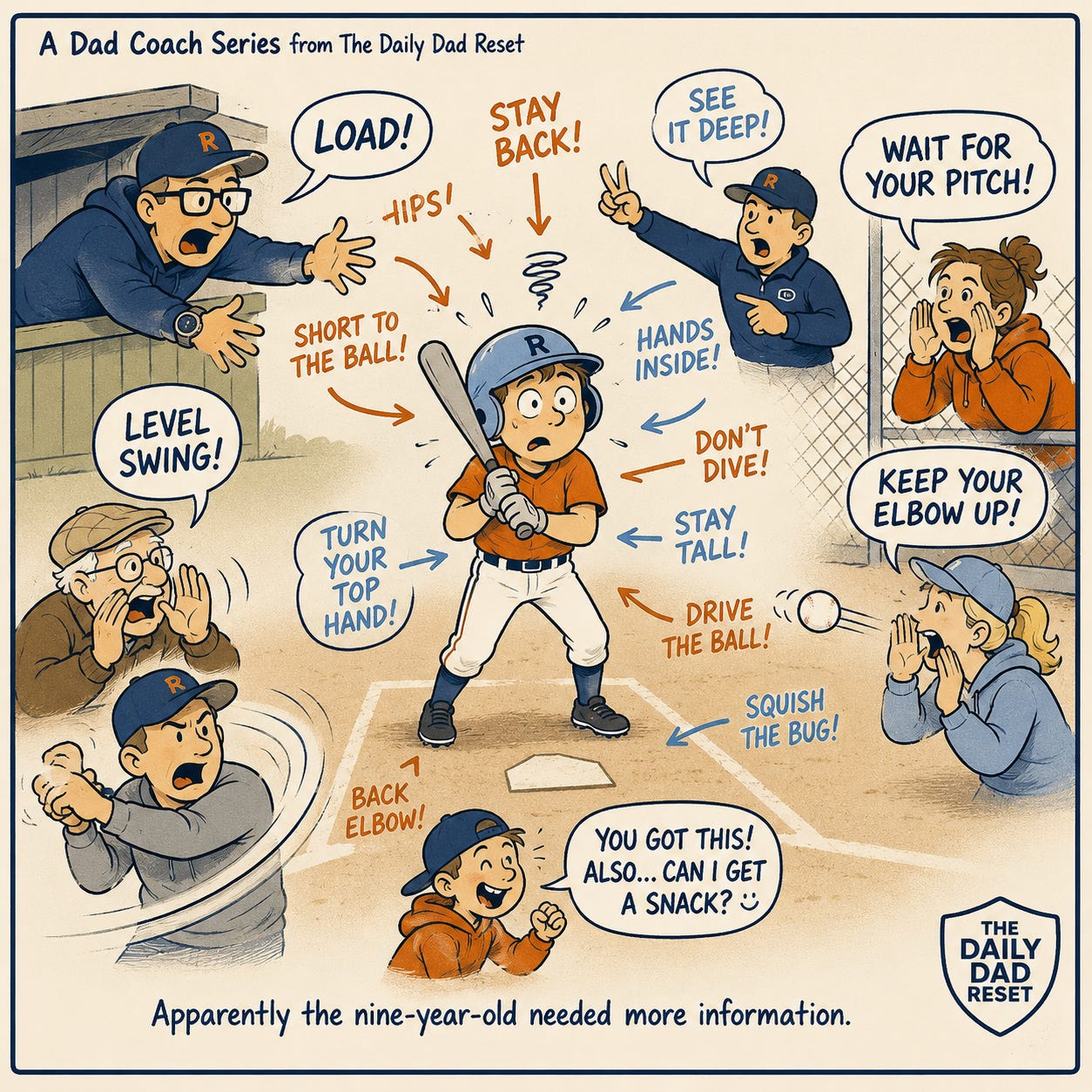
Throw in the countless “cues” well-intentioned parents gave during that at-bat, plus the private conference he received from his dad with seven more coaching points, and you have a recipe to get worse, not better.
Meanwhile, the kid is sitting there trying to remember whether he even likes baseball anymore.
Insight
Most kids don’t need another speech after a mistake. They already did the best they could, weither you think that or not. What they really need is one small adjustment, emotional safety, and another rep.
That’s it.
But adults often overcoach because mistakes make US uncomfortable. Especially when expectations are high, emotions are elevated, games feel important, our own kid is involved, or other kids appear to be succeeding with ease. So we flood kids with information.
And the wild part? The more emotional a kid becomes, the LESS instruction they can actually process. And when we think about emotional flooding, don’t just picture a kid throwing a helmet or bat. A kid can look calm on the outside…
and still be an emotional mess on the inside.
That’s why overcoaching usually creates confusion, hesitation, fear of mistakes, tightness, and robotic play. It rarely creates confidence. Because kids don’t play freely when they feel like every mistake becomes a lecture.
They start trying not to fail.
Because they begin to fear failure.
And the next time they’re in that same situation, they’ve got six cues from you, a pep talk from dad, and seven random voices yelling suggestions because they “care” all swirling around in their head.
Which usually makes everything worse.
Why It Works
The brain processes less information under stress.
Not more.
When kids feel embarrassed, frustrated, or overwhelmed, the thinking part of the brain becomes less efficient.
That’s why emotional flooding and over-instruction are such a brutal combination.
The kid already feels pressure. Then adults add more words, more mechanics, more correction, and more intensity. And suddenly baseball stops feeling athletic. It starts feeling like taking a math test while someone yells formulas at you.
Kids improve through repetition, confidence, adjustment, safety, and recovery. Not nonstop correction. The best coaches know how to simplify.
One correction.
One reminder.
One next step.
One practice rep.
Then let the kid breathe.
When you simplify everything into one small action, let them practice that action, and then remind them they can do it…
you give them something they actually remember.
Because they heard it.
And did it.
Reset
The next time a kid makes a mistake:
Pause before speaking.
Then ask yourself: “Does this kid need more instruction right now…or more confidence?”
If you correct something, make it small, specific, and calm.
One thing.
Not five.
Then let them get another rep.
Don’t just tell them they know how to do it.
And please don’t ask the horrible question:
“Do you get it?”
Show them they CAN do it by letting them try it again right there.
Then celebrate what improved.
Adjust again if needed.
And remind them: “You’ll get the next one.”
Because kids need opportunities to recover.
Not just opportunities to be corrected.
It’s such an easy trap to fall into because correction feels productive. It feels like we’re helping. But sometimes what a kid really needs is another rep and the belief that they’re capable of figuring it out.
Also loved the point that overcoaching is often about our discomfort, not theirs. That’s one of those observations that applies far beyond baseball.
Really well written and resonated with me. We finished baseball season last month and we tried our best to emphasize having fun and staying positive and not lecture on mistakes. It’s tough when you see so many parents putting pressure on their kids to succeed. One of the reasons I loved playing sports growing up was I got to play with my friends. Hoping to pass that onto my kids.