


Spring break had a wide-open day on the calendar. No plans. No schedule. No real reason not to do something memorable.
After the sticker shock of a trampoline park the day before, I wanted something free, outside, and new.
Enter mountain biking.
In my head, this was it, dad-of-the-year stuff. Fresh air. Adventure. Just enough challenge to push them. The perfect mix: fun with a hidden layer of growth underneath. Building resilience without them even realizing it.
LIFE CHANGING.
At least… that’s how I pictured it. We’d come back tired, proud, maybe even a little transformed. I’d sit there thinking, nailed it.
We’ve biked all over town the last couple summers, so I did what every dad does: I asked ChatGPT for a trail, picked one about an hour away, and pretended I knew exactly what we were getting into.
We loaded up the bikes and headed out. Somewhere between nervous and excited, we rolled onto a trail none of us had ever been on.
It started off great…
small climbs, fast downhills. I was coaching gears like I knew what I was doing. They took turns leading. Beautiful day. Lots of laughs. A couple near-misses when someone in the back didn’t anticipate the brakes in the front. We recovered, we laughed, we kept moving. It turns out we’re better at recovery than spacing.
And for a while… it felt exactly like I imagined.
Then we hit the middle.
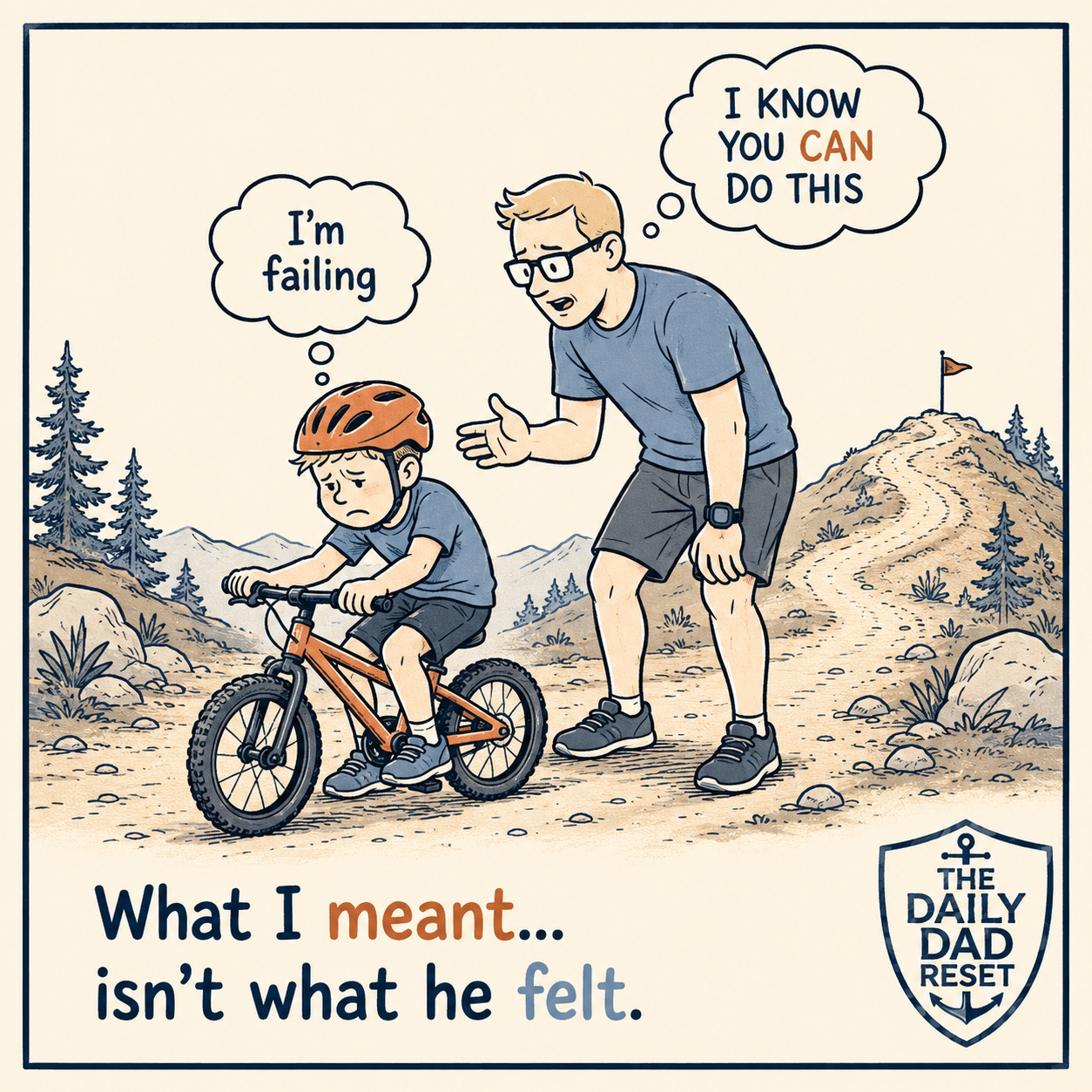
About halfway through, Hunter had to dismount on a climb he couldn’t get up. He said it: “I’m done.”
Not dramatic. Not loud.
Just… done.
If you’ve been there, you know what that means, not just tired. Legs burning. Breathing off. Confidence starting to slip. And now every hill feels bigger than it actually is.
This wasn’t the highlight reel anymore.
This was the part no one talks about.
The Moment Every Dad Feels
This is the moment…
when the vision in your head meets reality in front of you.
Push him? Fix it? Pull him out?
You can feel all three at once: “Come on, you’re fine.” “Let’s just walk it out.” “We can turn around.”
And if I’m honest, that wasn’t the only voice in my head. There was an older one too, the one I grew up with.
“Suck it up.” “Don’t show weakness.” “Quitting is for losers.”
It sounds like encouragement. It doesn’t feel like it when you’re the one on the bike.
I could feel it creeping in…
not out loud, but underneath. Frustration building. Because I knew something.
His legs weren’t done.
His mind was.
And that’s the part that gets you. When you know they can do it and they keep stopping, it’s easy to shift…
helping to pushing, encouraging to demanding. I’ve gone there before. Too many times.
But here’s what I’ve learned the hard way: if I let that frustration leak out, even a little, it makes everything worse.
Hunter’s an empath. He can smell frustration like a drug dog at an airport. A look. A sigh. A slightly sharper tone. And the second he senses it? His world gets smaller. The trail gets harder. “I can’t” gets louder. So before I could help him regulate…
I had to regulate myself.
Lower my tone. Slow my pace. Actually be calm...
not just pretend to be.
Because kids don’t respond to what we say.
They respond to what we bring.
There was another layer too: I had no idea where the quickest way back to the car was. Turn around? Keep going? Either way…
we were in it.
And weirdly, that helped. It forced me to stay in the moment instead of escape it.
Don’t pretend it’s not hard. But don’t let that be the reason we quit.
Because I’ve started to notice something over time: every time I remove the hard part too quickly, I also remove the exact moment where confidence has a chance to form.
What We Did Instead
We slowed it down...
not the trail, the moment.
We didn’t talk about finishing. We talked about the next section, then the next turn, then just getting to that tree.
No big speech. No “life lesson.”
Just staying in it.
Together.
While we did that, I wasn’t watching his legs.
I was watching his head.
Because once a kid decides they can’t, everything starts to feel like proof...
every hill, every bump, every mistake. It builds a case. A convincing one.
But if they stay in it long enough, long enough to interrupt that pattern with even a small win, something shifts.
Not all at once. Not dramatically.
Just enough.
A hill he made it up. A section he didn’t walk. A breath that came back under control.
And then…
he wasn’t done anymore.
We rode that last stretch back to the car, and like every well-planned dad adventure, there was a stash of gummy bears and chocolate waiting. This may or may not have been the real motivation the whole time.
But this is the part that matters most, the part we usually rush past, the part where we shape what they remember about the struggle.
We sat there, eating sugar like we earned it. I asked what their favorite part was. They shared jumps, hills, moments where they felt unstoppable.
Then I asked what the hardest part was. They shared that too.
And I watched Hunter’s face change.
His brothers talked about their own struggles...
where they almost got off, where they doubted themselves.
And you could see it click.
He wasn’t the only one.
When Hunter shared, it sounded different.
Not defeated.
Confident.
Like someone who didn’t just struggle…
but made it through.
What I’m Learning
There’s a difference between helping your kid… and saving them.
Helping stays with them.
Saving feels good in the moment, but it doesn’t travel with them the next time things get hard.
James 1:2–4 puts words to this in a way I keep coming back to: “Consider it pure joy… whenever you face trials of many kinds, because you know that the testing of your faith produces perseverance.”
That’s what I want for my boys...
not a life without hard, but a life where they know how to move through it, where they trust themselves, and know they’re not alone in it...
even when it feels like they are.
Why It Matters
Confidence isn’t built when things are easy.
It’s built right after “I can’t.”
But only if they stay in it long enough to see something different.
There’s something happening in the brain in that moment. When a kid hits “I can’t,” their brain starts looking for proof that they’re right...
every missed hill, every mistake, every hard breath. It builds a story, and the longer they stay stuck in it, the more real it feels.
But when they stay in it just a little longer—and experience even a small win—something shifts. Their brain starts updating the story.
“I can’t” becomes “maybe I can.”
And then eventually… “I did.”
That’s how confidence is built, not from avoiding the hard, but from experiencing it and making it through.
Reset This Week
When your kid hits the wall, don’t rush to remove it. Stay with them in it. Break it down. Slow it down. Help them take one more step, then another.
Not to prove something.
Just to keep going.
And start with you…
your tone, your pace, your presence.
Because if you can regulate that…
you give them a chance to regulate theirs.
Don’t steal the hard part from them.
That’s where the growth is.
And most of the time…
They’re closer than they think.
In the end and as he grows older, all he’ll remember is that you spent rime with each other. Those gummy bears were well deserved!🧸🧸🧸🧸🧸
The hard part is often the best part. Once it's over anyway.
My husband and I always remind ourselves we're raising adults, not children. Which means like you show, teaching them how to work through the hard stuff instead of saving them from it matters.
I think you both definitely earned those gummy bears. Good job, dad!
PS. why are trampoline parks so expensive!?