


A few nights ago, one of my boys melted down because his Lego build didn’t look the way he pictured it.
Not collapsed.
Not broken.
Just….off.
Which, apparently, was a personal insult to his vision, his abilities, and the entire Lego engineering profession.
My first instinct was to fix it.
To grab a piece.
To rotate something.
To say, “Here, just do this.”
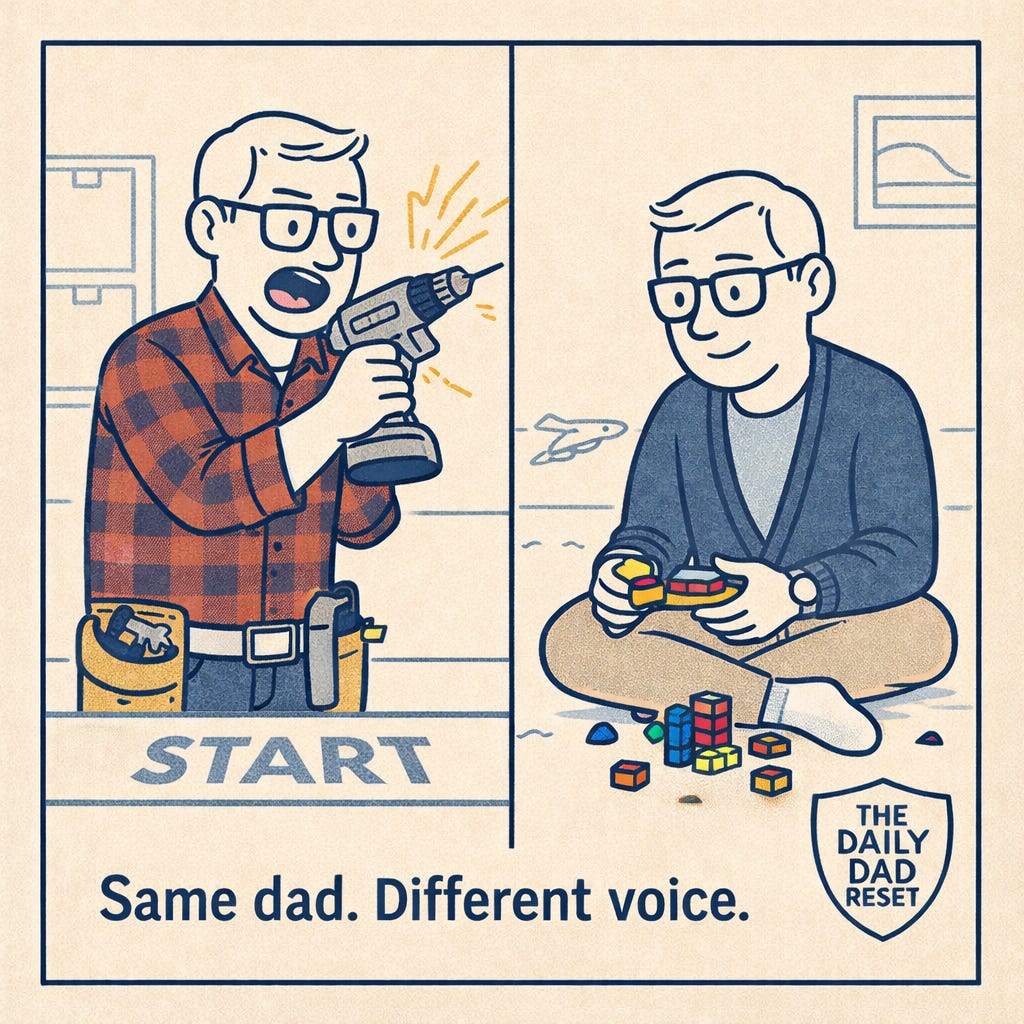
Part MacGyver, part Tim Taylor from Home Improvement, convinced I could fix it in under 30 seconds with confidence, duct tape, and absolutely no instruction manual…
and still look impressive doing it.
Instead, I caught myself and said something wildly underwhelming. Something much closer to what Mr. Rogers might say:
“Yeah. That’s frustrating.”
Then I added one sentence that mattered more than it looked:
“I see how much thought you put into it.”
Then I asked a simple question:
“Do you want a hug, some help, or both?”
He leaned over and gave me a long hug. I could feel his breathing slow, his shoulders soften, his body settle.
No lesson.
No speech.
No motivational poster about perseverance.
No Tony Robbins pump‑up talk.
No Rocky training montage set to inspirational music.
Five minutes later, he was rebuilding.
Ten minutes later, he was fine.
Which reminded me of something uncomfortable but important:
January doesn’t usually fall apart because motivation runs out.
It falls apart when reality doesn’t match the picture we had in our head.
Expectations: The Hidden Trigger
His issue wasn’t the Lego. It was the expectation he carried into it.
He had already built something in his mind.
Something great.
Something special.
Something that was going to be epic.
When the real thing didn’t match the imagined version, the joy collapsed. Not because the build failed…
but because the expectation did.
That gap between expectation and reality is where frustration lives.
And it’s the same place most January resolutions quietly unravel.
Why Motivation Breaks (and Formation Holds)
Most of us assume we’ll rise to our intentions when things get hard.
But under stress, we don’t rise.
We default.
Not just to habits…
but to expectations.
To how we thought this week would go.
To the version of ourselves we assumed we’d be by now.
To the silent rules we never named but still judge ourselves by.
When reality doesn’t match those expectations, it feels like failure…
even when progress is still happening.
That’s when the Tim Taylor voice shows up.
Fix it. Push harder. Power through. Don’t feel this.
Sometimes that voice works.
But more often, it turns unmet expectations into self-criticism, missed reps into quitting, and ordinary resistance into proof that something’s wrong.
That’s why motivation alone isn’t enough.
Because when pressure hits, the brain doesn’t just grab what’s familiar…
it grabs the expectations we’ve been rehearsing.
What holds isn’t motivation.
What holds is formation.
And formation sounds a lot less like Tim Taylor…
…and a lot more like Mr. Rogers.
What Microblessings Actually Are
Microblessings aren’t gratitude lists.
They’re not silver linings.
And they’re definitely not pretending things are fine when they’re not.
Microblessings are small, honest statements…
spoken quietly, often casually…
that widen the moment without turning into a lecture.
They’re the Mr. Rogers moments.
The calm voice.
The steady presence.
The sentence that names reality without shaming it.
They sound like:
“I see how much thought you put into that.”
“That was hard—and you stayed with it.”
“You didn’t quit when it got frustrating.”
“I noticed how patient you were.”
They don’t lower the bar.
They lower the pressure you have created through your own expectation setting.
Formation Happens Out Loud
Microblessings work best when they’re spoken out loud.
Because our kids don’t just hear what we say to them.
They hear what we say about effort, mistakes, and growth.
Over time, those words become the script they use on themselves.
Scripture puts it plainly:
“For as he thinketh in his heart, so is he…”
— Proverbs 23:7
Positive thinking is great, and it has its place in teaching mindsets.
This, however, is about formation.
Who we become is shaped slowly by what we rehearse internally…
and what we speak externally.
The Reset Reminder
You don’t need more motivation on hard days.
You need fewer unspoken expectations about how the day is supposed to go.
Notice the moment frustration shows up.
Name what didn’t match the picture in your head.
Then offer one steady sentence…
to yourself or your kids…
that keeps you in the room.
Because when expectations collapse, formation is what keeps you standing.
It' easy to say that one needs to listen to what people are saying, or that one needs to empathise … but sometimes one just needs to try different ways of listening / empathising… to truly communicate. Just a thought.