
A little reminder of what a dad coach is…..
Not the guy trying to make sure his kid always plays shortstop.
Not the coach treating a Tuesday night little league game like Game 7 of the World Series.
A dad coach is someone trying to be a good dad and a good coach at the same time.
Someone who wants kids to:
improve
compete
build confidence
learn resilience
and still have fun playing baseball
All kids. Especially their own. Because deep down, the real win isn’t just better players.
It’s kids who still love the game.
And kids, especially your own, hoping you coach again next season.
If you read this week’s article, you already know exactly what I’m talking about.
One error turns into three.
Kids get quieter.
Coaches get louder.
And suddenly everyone is acting like a dropped ground ball in March just eliminated them from the World Series.
You can feel the dugout change. Mistakes feel heavier. Everyone starts pressing.
And usually? Adults feel it too.
That’s the moment.
Not when kids stop listening but before it. Consider this Fieldwork FROM the dugout. Moments that you cannot help them practice doing something differently, but you still want to cue them towards improvement.
Your Fieldwork This Week
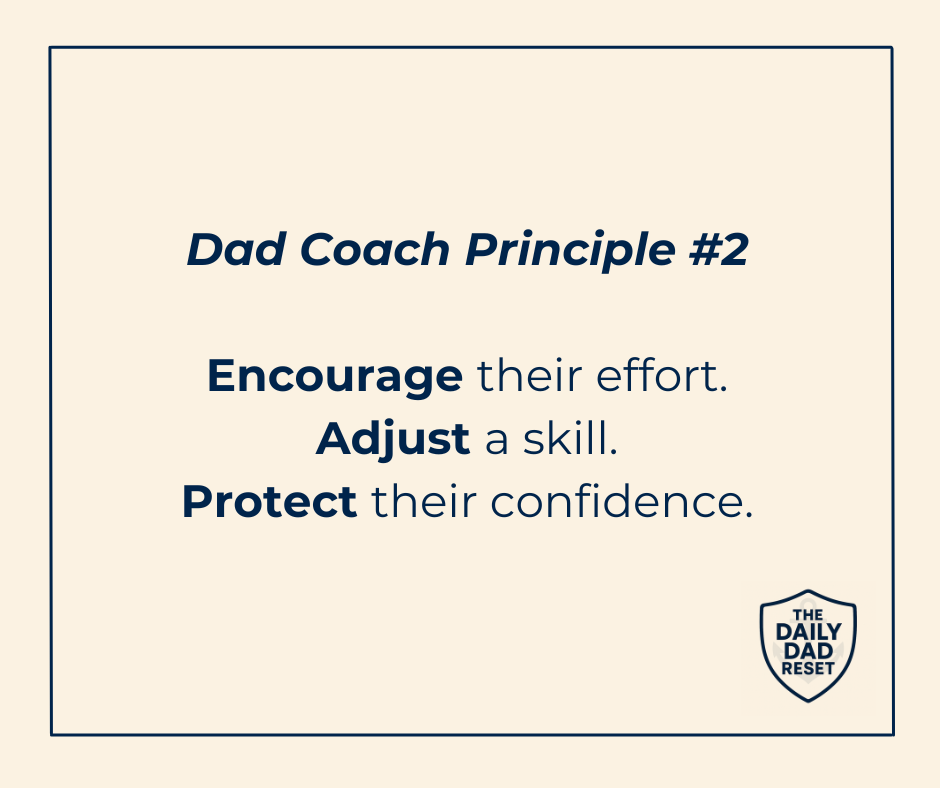
This week, try leaning into Dad Coach Principle #1
Encourage. Adjust. Believe.
Encourage their effort.
Adjust a skill.
Protect their confidence.
That order matters more than most coaches realize.
1. Encourage
Pick one kid to watch differently. Not the best player. Not the loudest player.
Watch the kid who changes after mistakes.
The one who:
gets quiet
speeds up
avoids eye contact
jokes to cover nerves
looks defeated after errors
Then catch something good immediately. Not fake praise. Something real and specific.
“Way to stay with it.”
“I liked how you moved your feet there.”
“Way to swing all the way through.”
2. Adjust
Add ONE small correction. Not a full coaching clinic.
One thing. Small. Doable.
“Next time keep your glove in the dirt.”
“Try staying through the ball.”
“Keep your head down a little longer.”
That’s it.
3. Believe
Before they walk away:
fist bump
eye contact
encouragement
calm tone
Something that says:
“You’re okay here.”
Because kids can handle correction.
What they struggle with…
is feeling alone inside it.
Why It Matters
A kid boots a ground ball. You can see it on his face immediately.
Embarrassed.
Frustrated.
Waiting for the reaction.
Now imagine this:
“Way to stay with it. I liked how you got in front of it.”
“Next time keep your glove in the dirt a little longer.”
fist bump “You’re alright. Get the next one.”
That kid walks away thinking:
“I can do this.”
Kids don’t learn well in survival mode. When pressure feels too big, their brain shifts from learning…
to protecting.
That’s when confidence shrinks. Risk-taking disappears. And baseball (or any sport) stops being fun. But when kids feel safe?
They try more. Recover faster. And honestly…
play better.